Math

Deliver expert-level exam grading and personalised feedback at a fraction of the cost and time. Help teachers assign more practice, increase A-Level performance, and prepare students for top universities worldwide.
Deliver expert-level exam grading and personalised feedback at a fraction of the cost and time. Help teachers assign more practice, increase A-Level performance, and prepare students for top universities worldwide.

Cortex Global allows schools to assign significantly more practice work without increasing marking workload. From A-Level practice exercises to full mock examinations, schools can deliver high-quality feedback quickly, consistently, and affordably.
Free teachers from repetitive marking while giving students more chances to improve before final examinations.
Affordable at department and whole-school scale.
Fast feedback cycles after mocks and practice work.
More practice without expanding marking load.
Structured guidance for the next attempt.
Cortex Global supports both major exam boards with expert grading across STEM and other subjects.
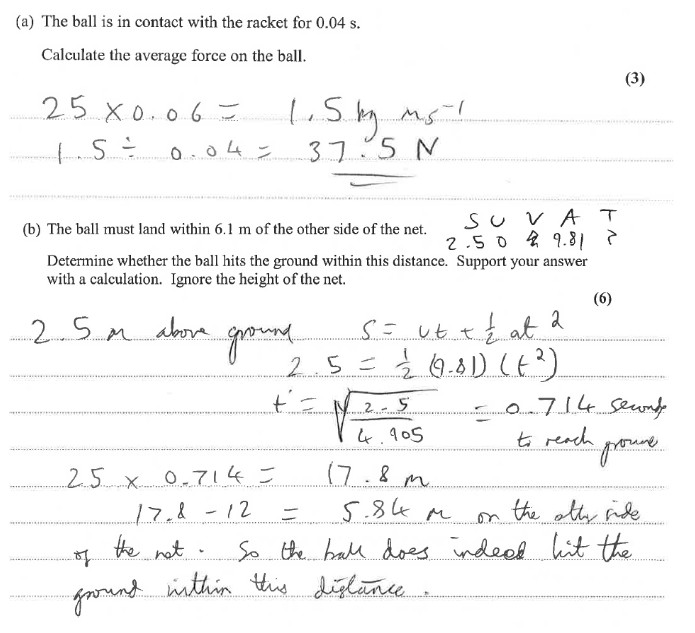
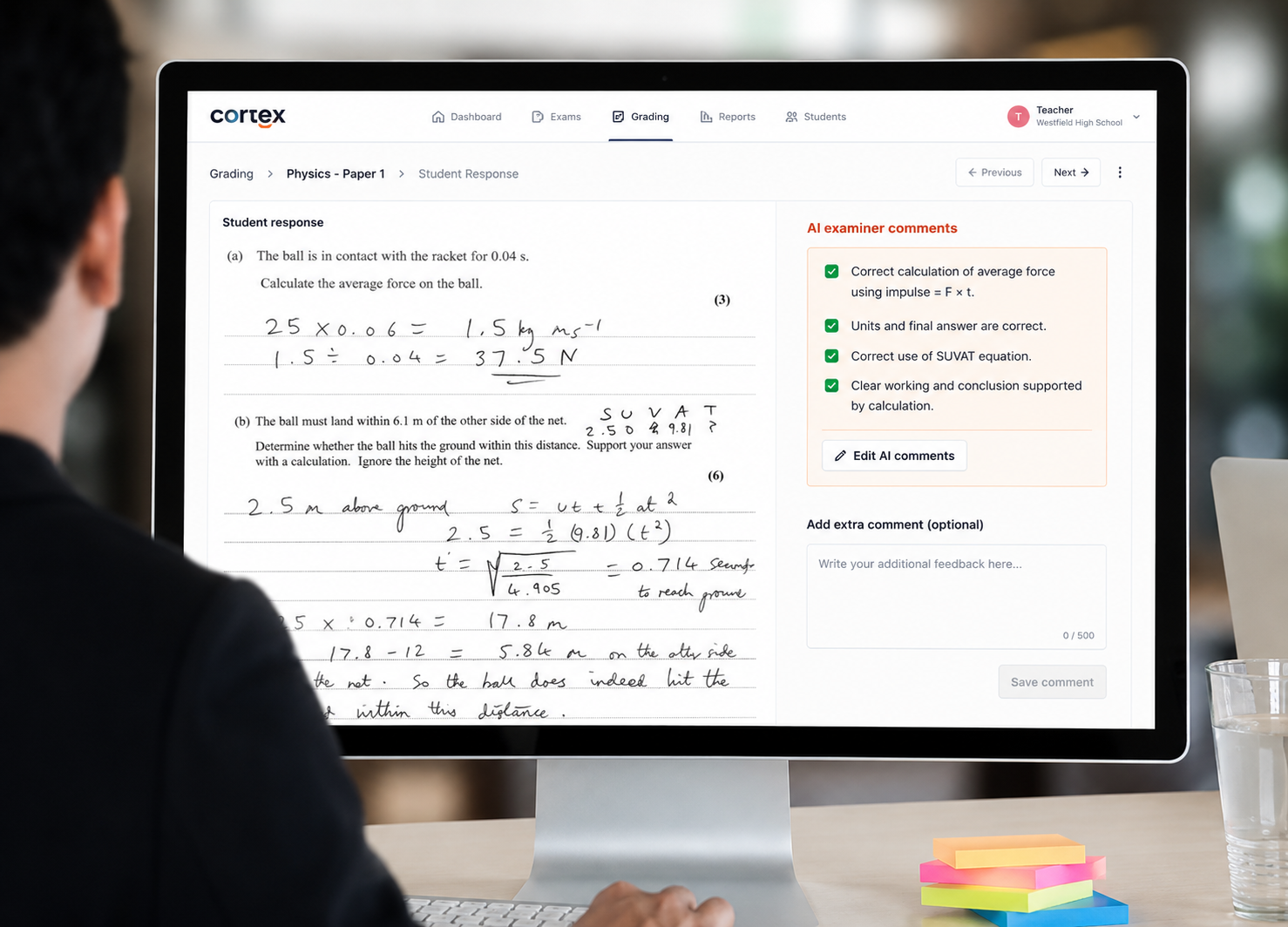
Part (a) is fully correct: the impulse calculation, force calculation, and unit are all accurate.
Part (b) is also correct. Your SUVAT method leads to a clear horizontal distance and a valid conclusion.
To improve exam technique, explicitly state your final comparison: 5.8 m is within 6.1 m, so the ball lands in the required distance.
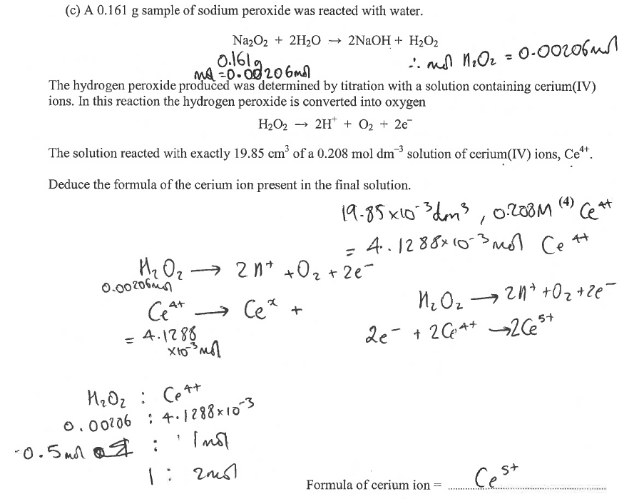
You correctly calculated the moles of Ce⁴⁺ and H₂O₂, then used the mole ratio accurately.
The final ion should be Ce³⁺, not Ce⁵⁺. Revisit oxidation states and practise half-equation interpretation.
When writing final ionic formulae, check that the electron gain or loss matches the oxidation-state change.
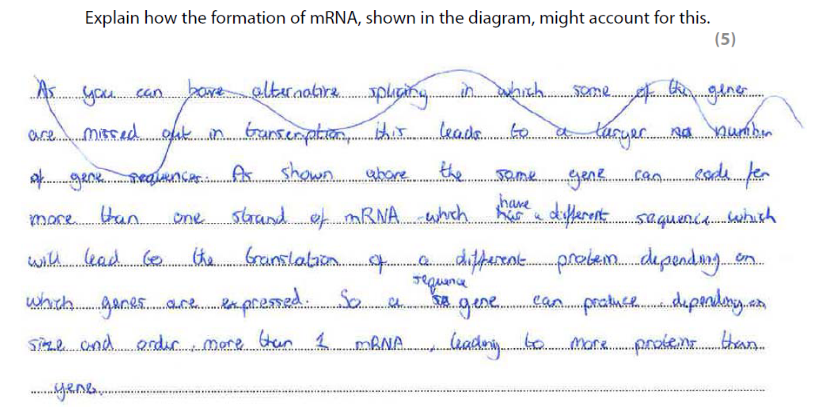
You gain credit for recognising that alternative splicing can produce different mRNA transcripts.
The explanation is not clear enough about how exons are joined and how this changes the amino acid sequence.
Revise transcription, mRNA processing, introns/exons, and how different proteins can be produced from one gene.
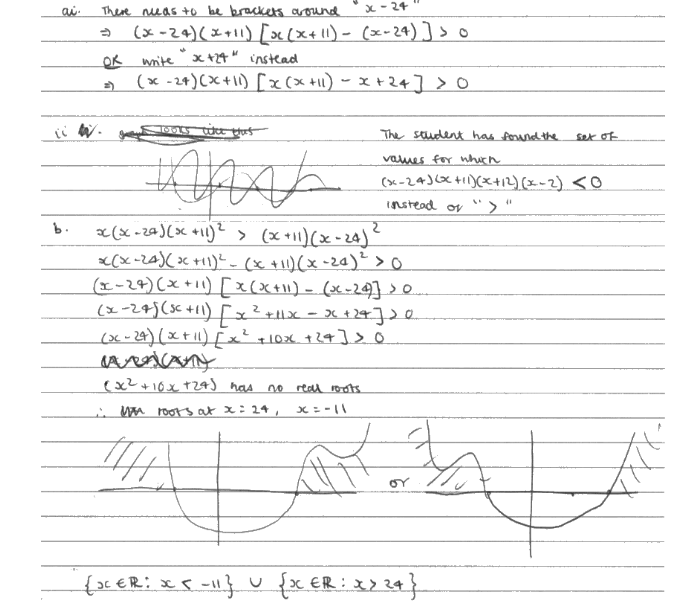
Parts (a)(i) and (a)(ii) receive credit for acceptable explanations.
In part (b), an earlier algebraic error prevents a correct inequality solution.
Revise solving quadratic inequalities: identify roots accurately, sketch the sign pattern, and select the correct outside or middle interval.
Separate experiences for teachers and students make it easy to assign work, collect submissions, review feedback, and monitor performance across classes and departments.

Give students more opportunities to improve while allowing teachers to focus on higher-value academic support instead of repetitive marking.
Students are consistently losing marks on momentum and impulse questions.
Vector geometry questions are producing lower-than-average scores across two classes.
Use department-level statistics to improve revision planning, strengthen intervention, and support better final outcomes.
For schools with international ambitions, stronger exam preparation means students can approach university applications with clearer evidence of progress, stronger subject mastery, and more confidence in competitive academic routes.

Organise a free pilot and see how Cortex Global can help teachers save time, increase practice opportunities, and improve student outcomes.
Built for ambitious schools preparing students for top academic outcomes.
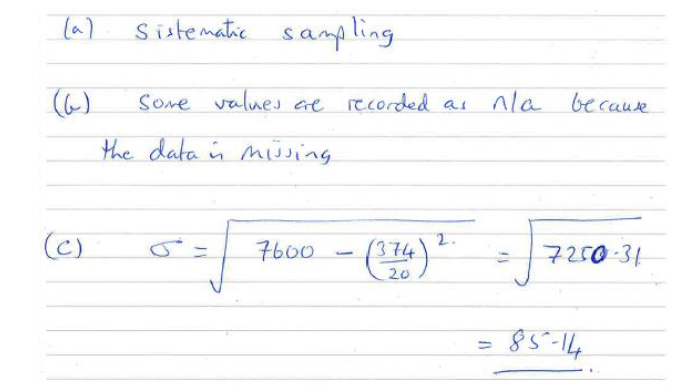
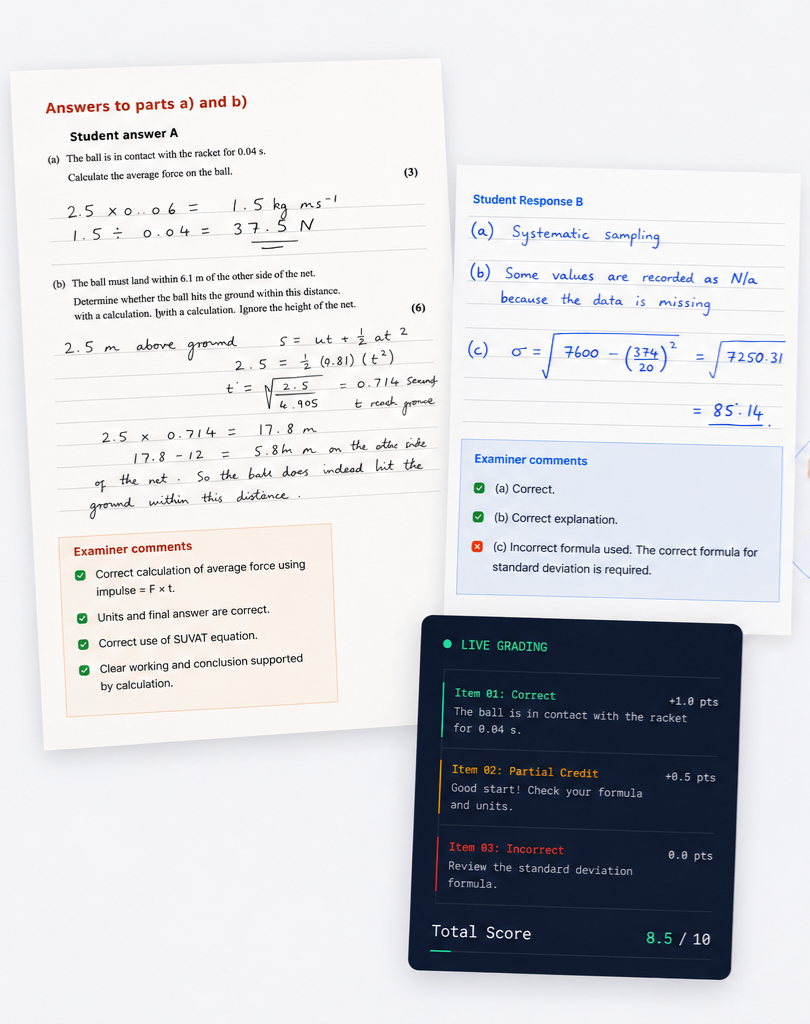
Part (a) is correct. Spelling is not penalised here because the sampling method is clearly identifiable.
Part (b) is correct: you recognised that missing data explains the N/a entries.
Part (c) uses the wrong standard deviation formula. Revise the correct formula and practise substitution questions using summary statistics.